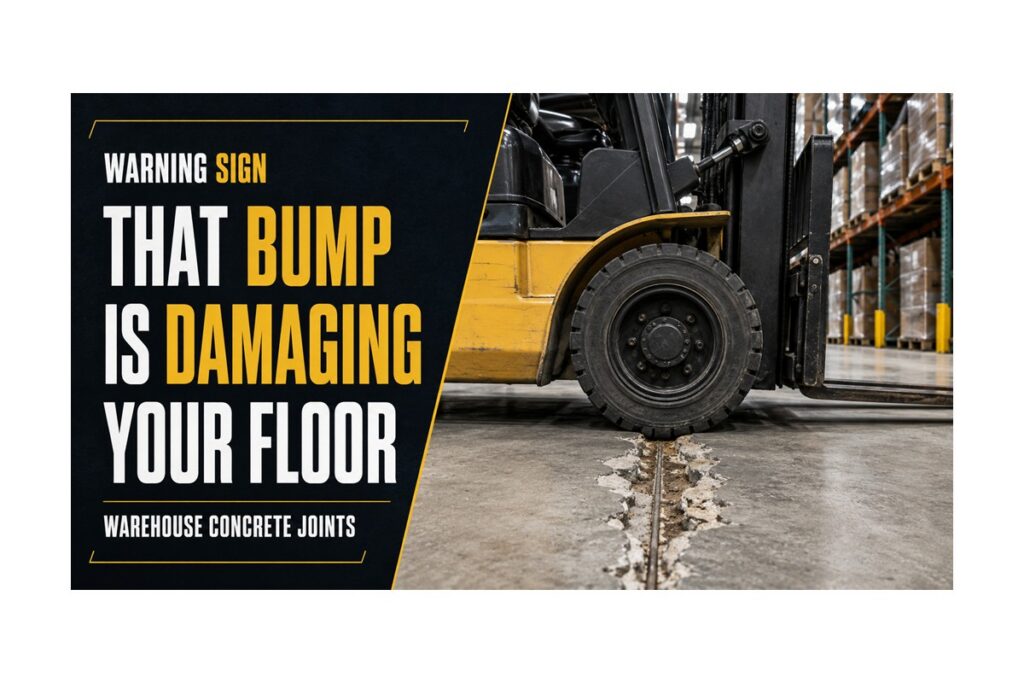


Warehouse concrete floor joint repair is one of the most common maintenance needs in industrial facilities across the Kansas City metro area. From distribution centers in Kansas City, Kansas, to warehouses throughout Lenexa, Olathe, Overland Park, and the Missouri side, joint failure is a leading cause of slab damage, forklift wear, and safety concerns. When joints deteriorate, forklift wheels impact the joint edges thousands of times per day. Over time, this repetitive traffic causes joint edges to break down, creates vibration for operators, and accelerates damage to both equipment and the slab itself. Understanding joint types, joint condition, and the correct repair approach is critical to controlling long-term costs.
(VIDEO TRANSCRIPT BELOW)
Why Concrete Joints Exist
- Concrete joints are intentionally installed to control cracking and allow slab movement caused by temperature changes, moisture changes, and heavy traffic loads.
- Concrete naturally expands, contracts, and shifts over time. Joints create planned areas where that movement can occur without causing random cracking across the slab surface.
- Problems arise when joints are damaged, improperly filled, or repaired without respecting the natural movement of the concrete.
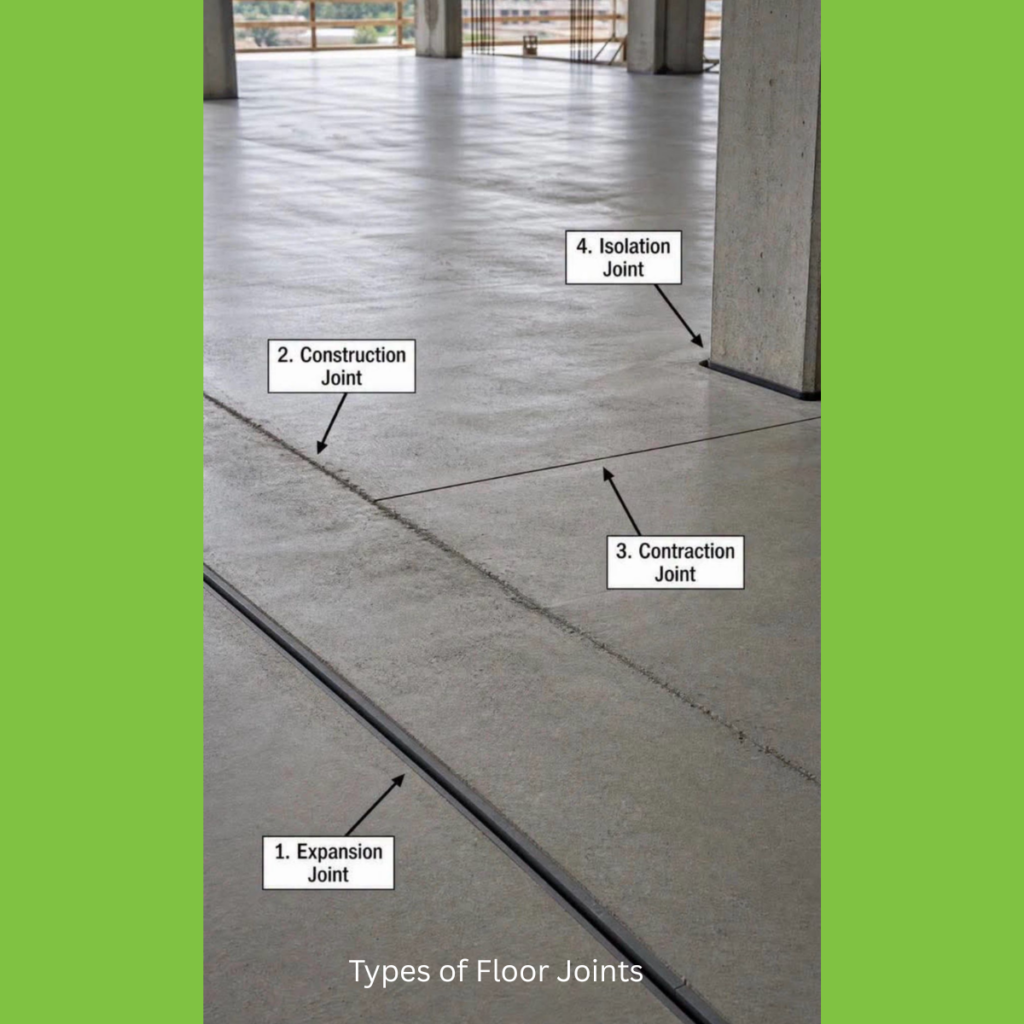
Most warehouse floors in the Kansas City region contain three main joint types:
Expansion Joints
- Expansion joints are designed to absorb slab movement. They are typically wider than other joints and are often located near walls, columns, dock doors, or transitions between slabs. These joints must remain flexible to allow movement. Filling them with rigid materials can cause significant slab stress and cracking.
Control Joints
- Control joints are saw-cut joints designed to control where cracking occurs as the concrete cures and shrinks. These joints are very common throughout warehouse floors and frequently experience damage when forklift traffic repeatedly strikes unprotected edges.
Construction Joints
- Construction joints occur where one concrete pour stops and another begins. Because these joints often transfer load between slabs, they tend to experience significant stress from heavy equipment and forklift traffic. Edge deterioration at construction joints is one of the most common repair issues seen in active distribution centers.
Are the Joint Edges Broken?
Joint edge condition is one of the biggest cost drivers in warehouse joint repair.
Minor Damage
Minor damage includes light chipping or surface wear with mostly intact edges. In these cases, the repair may involve cleaning the joint and installing a semi-rigid joint filler to protect the edges from further impact. These repairs are typically faster and less expensive.
Severe Damage
Severe damage includes broken or crumbling edges, forklift impact damage, and loss of load transfer across the joint. These repairs require additional steps such as saw cutting the damaged section, rebuilding the joint edges with specialized repair materials, and reconstructing the joint before installing the filler. This process increases both labor time and overall cost.
Why Honoring the Joint Matters
One of the most common mistakes seen in Kansas City warehouses is filling joints solid without honoring the movement of the slab. When joints are not honored, the concrete has nowhere to move. The result is cracked repairs, failed fillers, and repeated repair cycles that drive maintenance costs higher. Proper joint repair must respect slab movement, load transfer, and traffic direction. A correctly repaired joint protects the surrounding slab and reduces long-term deterioration.
Using the Proper Joint Filler
Choosing the right joint filler is essential for warehouse durability.

Rigid Joint Fillers
Rigid fillers are used in environments where heavy forklift traffic requires strong edge protection. They are best suited for control joints and construction joints where minimizing edge impact is critical.
Semi-Rigid Joint Fillers
Semi-rigid fillers are the most common choice for Kansas City warehouses. They provide edge protection while still allowing minor slab movement. This balance makes them ideal for high-traffic industrial environments.
UV-Stable Joint Fillers
In areas near dock doors or exterior openings, UV exposure can degrade some filler materials over time. UV-stable fillers are designed to resist sunlight exposure and maintain flexibility and strength.

Cost Range for Kansas City Warehouses
In the Kansas City market, warehouse concrete floor joint repair typically ranges between $3 and $6 per linear foot. Pricing depends on several factors:
- Type of joint being repaired
- Severity of joint edge damage
- Total linear footage involved
- Accessibility within the facility
- Whether work must be completed during off-hours
- Phasing requirements to keep operations running
- Minor joint filling with intact edges generally falls toward the lower end of the range, while joint reconstruction and edge rebuilding typically fall toward the higher end.
- Large facilities often benefit from repairing joints in phases to minimize disruption while maintaining floor integrity.
Summary
- Concrete floor joint repair is not cosmetic. It is a structural and operational investment that protects slabs, equipment, and personnel.
- Correct joint identification, honoring slab movement, and using the proper joint filler can significantly reduce repeat repairs and long-term maintenance costs.
- For warehouses and distribution centers with heavy forklift traffic, proactive joint maintenance often prevents larger and more expensive slab repairs in the future.
➜ Learn how professional Warehouse Joint Filler Installation protects concrete joint edges and reduced repeated forklift impact.
Frequently Asked Questions
How long does warehouse joint repair last?
When properly installed, semi-rigid joint fillers in warehouses can last 5 to 10 years or longer, depending on forklift traffic, load weights, and floor conditions. Regular inspections help catch early damage before it spreads.
Does warehouse joint repair require shutting down operations?
Not always. Many facilities complete joint repair in phases during off-hours or weekends so that warehouse operations can continue. The repair schedule is often designed around traffic patterns and operational needs.
When should warehouse floor joints be repaired?
Joint repair should be considered when you begin to notice joint edge chipping, forklift vibration, loose filler material, or debris collecting inside joints. Addressing these issues early typically reduces repair costs and prevents larger slab damage.
If you want a clear recommendation, we can walk your space, assess your floors, and help you develop a plan that fits your facility’s needs. Call 913-322-6200 or email [email protected] to start the conversation today.
(Video Transcript)
Today, we are rebuilding an expansion joint in a facility where forklifts travel back and forth all day. That constant forklift traffic can cause serious damage. If you look at this joint, you can see that the existing filler is very thick and wide. Joint filler can be flexible, but it has limitations. This joint is simply too wide.
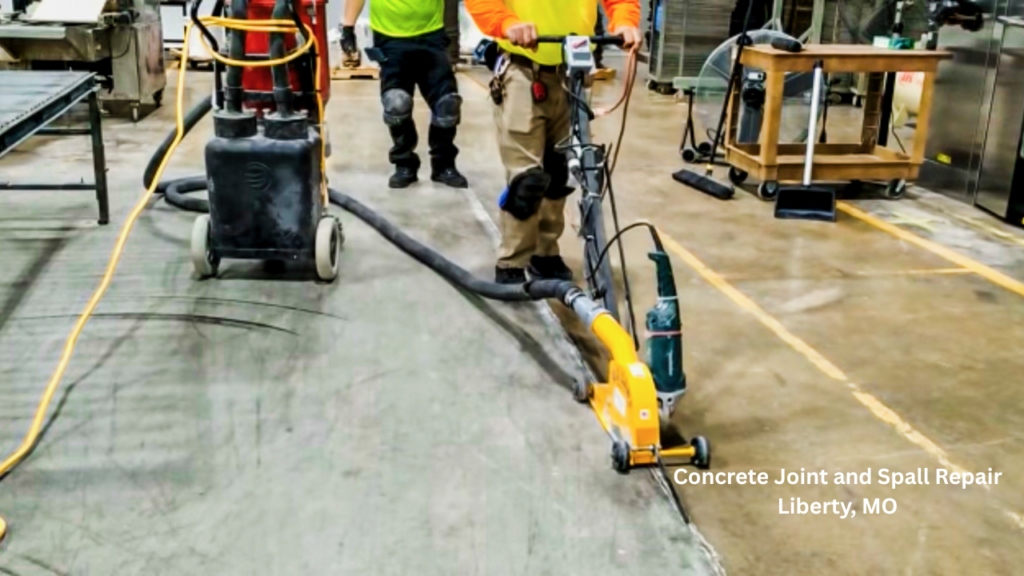
We are going to cut approximately two inches out on each side, remove the damaged concrete and deteriorated filler, and install a fast-curing repair material. After the repair material cures, we will recut the joint to the proper size and fill it with the correct joint filler. Joint fillers have limitations. What you see here is only a temporary patch. It will fail, and the damaged area will continue to get wider. The wider the joint becomes, the weaker the repair becomes. The proper repair is to cut back the damaged edges, rebuild the area with new repair material, recut the joint to the correct dimensions, and fill it with the proper joint filler.
Because we are working in a sensitive environment, we use vacuums equipped with HEPA filtration. The filtration system helps control the dust, keeps the work area clean, and helps protect both our crew and the customer. Every machine we use to cut the concrete is connected to a vacuum.
We use different types of blades for different purposes. When we need to remove failing joint filler, we use the Tiger blade. As the old material is removed, friction and heat can make the joint filler sticky and difficult to extract. The Tiger blade is designed to handle that challenge. The other blade is designed to cut deeper and remove a larger amount of concrete. These are two different blade designs for two different purposes.
The inside walls of the joint must be very clean so the new joint filler can properly adhere to them. Next, we are getting ready to mix Parts A and B of the repair material and place it in the area we are rebuilding. After it cures, we will recut and fill the joint. There is not much working time with this product. Once Parts A and B are mixed, we have to move quickly. We chose gray because it is close to the color of the existing concrete.
This repair material was installed approximately 25 minutes ago. That shows how quickly it cures and how we can get the facility back to work with very little downtime. Jason is now grinding the resinous repair material flush with the surrounding concrete. After grinding, we will apply a clear polyaspartic sealer. The sealer is UV-stable, so it will not amber or change color over time. The next step is to clean the joint and install the joint filler.
Pablo is setting up the joint-filling machine. The product has an A side and a B side. The pump mixes the two components at the specified 1:1 ratio, and the material passes through a static mixer so it is fully combined and ready to install. The A and B components are now flowing through the machine. Because the machine was cleaned before use, Pablo first flushes the cleaning chemical from the lines before installing the joint filler.
We are now at the final stage of the joint repair. The repaired area will receive a polyaspartic topcoat to help protect it from forklift tire marks. This is an important step because the repair material contains silica sand, which creates a surface similar to sandpaper. Without a protective coating, forklift tires could leave marks on the repaired area. Jason is cutting a small termination groove that will create a clean stopping point for the clear polyaspartic coating. Jason is applying one coat of clear polyaspartic to protect the repaired area.
The project is now complete.

Dana writes about commercial cleaning, healthcare environmental services, and professional floor care for Kansas City facilities. Through Advanced 360 Total Floor Care and Sani-SAFE Kansas City, Dana shares real-world guidance on facility maintenance, infection prevention, floor preservation, inspection readiness, and creating cleaner, safer environments.